Kampala, Uganda – Thursday 13th August 2026
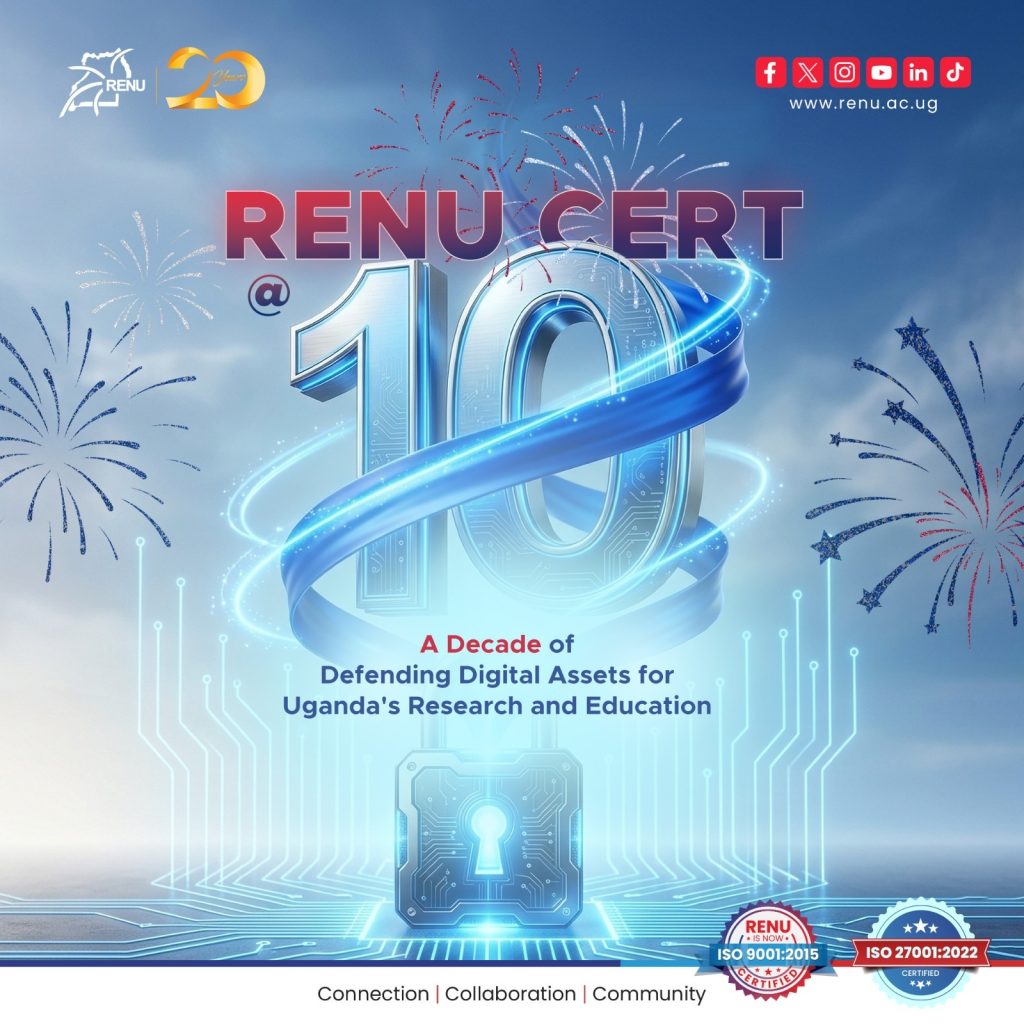
On 5th August 2026, the Research and Education Network for Uganda (RENU) celebrated 10 years of the RENU Computer Emergency Response Team (RENU-CERT), marking a decade of strengthening cybersecurity and protecting Uganda’s research and education community against an increasingly complex cyber threat landscape.
Today, RENU-CERT is recognised as a trusted cybersecurity partner, providing incident response, cyber resilience, threat intelligence and capacity building to RENU’s member institutions. Its story began long before its official establishment in 2016.
From Connecting Institutions to Protecting Them
When RENU was established in 2006, its first collaborative priority was clear: to reduce the cost of international Internet bandwidth and improve the quality of connectivity for Uganda’s universities and research institutions. At the time, access to reliable, high-speed Internet remained prohibitively expensive, limiting opportunities for teaching, learning, research, and international collaboration.
Over the following years, RENU worked with national, regional and international partners to transform Uganda’s research and education landscape with high-speed Internet, after being granted a licence in 2010 to operate its private network. The impact was transformative. Institutions, for the first time, were able to collaborate more effectively across borders, access global research resources, deliver digital learning and share knowledge at unprecedented speeds.
However, every new connection also introduced new risks. As RENU expanded its high-speed connectivity to universities, schools, and research institutions across Uganda, the volume of Internet traffic traversing the network increased significantly. While this created unprecedented opportunities for teaching, learning, research, and collaboration, it also increased exposure to cyber threats, making it essential to protect digital infrastructure, research data and institutional systems.
Recognising that protecting knowledge would become just as important as connecting it, RENU established the RENU-CERT on 5th August 2016. Initially created to coordinate the prevention, detection, response to, and recovery from cybersecurity incidents affecting member institutions, the service became fully operational across the RENU membership in 2019.
Established within RENU’s Systems and Software Department, RENU-CERT was envisioned as more than an incident response service. Its mandate included strengthening cyber resilience across the research and education community through cybersecurity awareness, sharing threat intelligence, support for secure digital practices and helping member institutions to confidently adopt emerging technologies.
Today, RENU-CERT comprises experienced cybersecurity professionals who work closely with institutional ICT teams to identify vulnerabilities, respond to incidents and strengthen cyber defences before attacks can disrupt institutional operations.
RENU-CERT also forms an integral part of Uganda’s national cybersecurity ecosystem through its affiliation with the Uganda Communications Commission’s UCC-CERT and the National Computer Emergency Response Team (CERT.UG/CC under the National Information Technology Authority-Uganda (NITA-U).
Its reputation has continued to grow beyond Uganda’s borders.
In October 2024, RENU-CERT attained Listed status in the Trusted Introducer (TI) Directory under the TF-CSIRT framework, officially joining an international community of trusted Computer Security Incident Response Teams (CSIRTs). This recognition demonstrates that RENU-CERT operates in line with internationally recognised standards for incident response, operational maturity and trusted information sharing, enabling stronger collaboration with peer CSIRTs across the globe.
Growing from an Incident Response Team to a Comprehensive Cybersecurity Service
Over the past decade, RENU-CERT has evolved from a specialised incident response capability into a comprehensive cybersecurity service supporting the diverse needs of Uganda’s research and education community. Today, RENU-CERT delivers a broad portfolio of services designed to help institutions prevent cyberattacks, strengthen resilience and recover quickly when incidents occur.
These services include:
- Incident handling, where cybersecurity specialists coordinate responses to cyber incidents, provide technical support during investigations and share timely alerts on emerging threats affecting member institutions.
- Cybersecurity auditing, which proactively identifies weaknesses in institutional networks, applications and systems before malicious actors can exploit them.
- Information dissemination, through cybersecurity advisories, threat intelligence, vulnerability notifications and best-practice guidance that help institutions stay ahead of emerging cyber risks.
- Email spam filtering, protecting institutional email systems against phishing attacks, malware and other malicious messages that remain among the leading causes of cyber incidents.
- Application filtering, enabling institutions to control access to malicious or inappropriate online content while improving network security and optimising Internet bandwidth utilisation.
- eduVPN services, providing secure remote access for staff, researchers and students to institutional resources while protecting communications across public networks or when working away from their institutions.
- Backup and recovery service, helping institutions strengthen business continuity and recover critical information following cyber incidents or system failures.
- Cybersecurity awareness and technical capacity building, equipping ICT teams, institutional leaders and end users with practical knowledge to recognise cyber threats, adopt secure digital practices and foster a culture of cybersecurity.
- External Attack Surface Management (EASM),continuously identifying, monitoring and assessing internet-facing digital assets to detect vulnerabilities, misconfigurations and potential security exposures before they can be exploited by cyber attackers.
Together, these services reflect RENU’s belief that effective cybersecurity is not simply about responding to attacks, but about creating resilient institutions capable of embracing digital transformation with confidence.
The Numbers Tell the Story, The Impact Defines Success.
Over the years, RENU-CERT’s impact has been both measurable and meaningful.
Between April 2019 and May 2025, the team successfully handled 251 notable cybersecurity incidents, helping member institutions minimise operational disruption and protect critical digital assets. During the same period, RENU-CERT conducted 12 penetration tests, enabling institutions to identify and remediate security weaknesses before they could be exploited by malicious actors. The team also integrated email spam filtering solutions for over 20 institutions and implemented a centralized application filtering solution serving all institutions, while supporting dedicated deployments at over 10 institutions requiring customized application filtering, significantly strengthening the security posture of institutional networks across the RENU community.
But, the true significance of these achievements cannot be measured by statistics alone.
In 2024, RENU-CERT further strengthened the trustworthiness of RENU’s digital services by achieving 93% compliance with the Security Incident Response Trust Framework for Federated Identity (SIRTFI) for the RENU Identity Federation. This milestone enhanced trust among identity federation partners by demonstrating RENU’s ability to coordinate and respond effectively to security incidents affecting federated identity services.
The team’s contribution extended even further with its pivotal role in RENU’s successful attainment of ISO/IEC 27001:2022 certification for its Information Security Management System (ISMS). Achieving ISO 27001 certification represented far more than meeting an international standard. It demonstrated that information security is embedded throughout RENU’s governance, risk management and operational processes. RENU-CERT played a central role in strengthening security controls, improving incident management processes and supporting a culture of continual improvement that assures member institutions and partners that RENU’s digital infrastructure and services are managed in accordance with globally recognised information security best practices.
More than a certification, ISO 27001 demonstrates that information security is embedded throughout RENU’s operations. It provides assurance to member institutions, partners and the wider research and education community that RENU’s services, including connectivity, cloud hosting, software development and digital platforms, are governed by internationally recognised practices that protect the confidentiality, integrity and availability of information.
Every cyber incident successfully mitigated represents uninterrupted teaching and learning, protected research data, secure institutional operations and preserved trust in the digital services upon which education and research increasingly depend.
A Trusted Partner in Times of Crisis
The value of RENU-CERT became especially evident during the COVID-19 pandemic. As institutions rapidly transitioned to remote teaching, online examinations and virtual collaboration, ICT teams faced the dual challenge of enabling secure remote access while defending institutional systems against rising cyber threats.
Several institutions turned to RENU-CERT for specialised support. Among them was Uganda Christian University (UCU), which requested an authorised cybersecurity vulnerability assessment and penetration test of its ICT infrastructure. The exercise enabled the university to identify security weaknesses, strengthen its systems and reduce potential cyber risks before they could affect critical services.
For many institutions, RENU-CERT became more than a service provider. It became a trusted partner. Reflecting on the team’s support, Nixon Kamugisha, Systems Administrator at Soroti University, said:
“We have always engaged RENU-CERT whenever we detect abnormal traffic on the network, and their swift support is top-notch. The team conducted comprehensive vulnerability scanning, which helped us identify and fix bottlenecks in our network and systems. They also supported the implementation of eduVPN using our local Single Sign-On tools.”
Building Capacity for a More Resilient Sector
RENU-CERT recognises that lasting cybersecurity cannot depend solely on technology. It depends equally on people. The team has invested significantly in strengthening cybersecurity capacity across member institutions, training over 300 ICT professionals and students through capacity-building initiatives, including awareness campaigns, specialised technical training, workshops and knowledge-sharing initiatives.
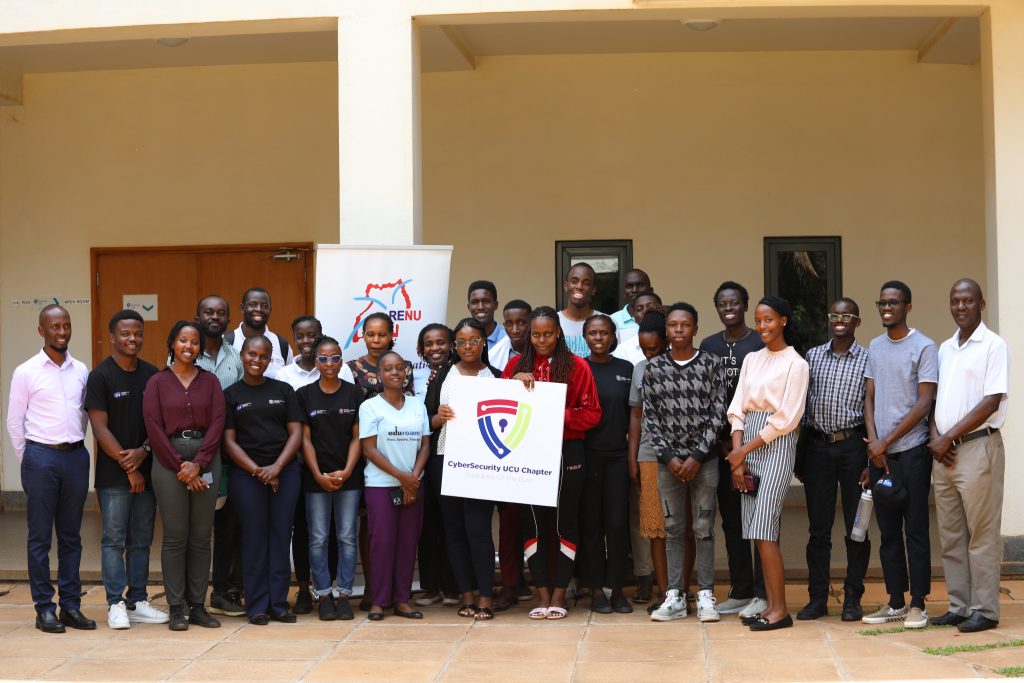
These efforts have empowered ICT professionals to anticipate, prevent and respond to cyber threats more effectively while encouraging institutional leaders and end users to view cybersecurity as a shared responsibility rather than solely an ICT function.
One recent example was the Business Continuity and Disaster Recovery (BC/DR) Training Workshop conducted in June 2026, which equipped participants with practical approaches to protecting critical institutional services during disruptive events.
Benard Oriyo, an assistant ICT officer at Gulu University, said the training had strengthened his ability to support ICT continuity planning at the university:
“The training significantly enhanced my understanding and capacity to support ICT continuity planning at Gulu University. The knowledge gained provided a strong foundation for improving institutional preparedness, protecting critical assets and ensuring reliable delivery of academic and administrative services during disruptive events.”
Securing Uganda’s Digital Future
As Uganda continues to expand digital education, cloud services, research collaboration, identity federation and emerging technologies such as Artificial Intelligence, cybersecurity becomes an increasingly important enabler of innovation. Without a secure digital infrastructure, institutions cannot confidently embrace the technologies shaping the future of education and research.
By safeguarding these foundations, RENU-CERT helps create an environment where educators can teach without disruption, researchers can collaborate securely, students can access digital learning resources with confidence, and institutions can innovate knowing their systems are protected. Its contribution, therefore, extends far beyond cybersecurity. It underpins Uganda’s growing knowledge economy.
Looking Ahead
As RENU continues expanding digital infrastructure, from cloud services and identity federation to artificial intelligence and advanced research platforms, the role of RENU-CERT will become even more critical. Every new digital service depends on trust, and every trusted service depends on strong cybersecurity.
The first decade of RENU-CERT was about building resilience. The next decade will be about enabling innovation with confidence, ensuring that Uganda’s researchers, educators, students, and institutions can connect, collaborate and create in a secure digital environment.
Because protecting knowledge is no longer just part of RENU’s mission. It is fundamental to it.