Stay securely connected while travelling across 190+ countries with eduroam on the Go
Kampala, Uganda — Wednesady 1st July 2026
For many researchers, students, lecturers, and university staff, travelling abroad often means losing access to the trusted and secure connectivity they rely on at their home institutions. Instead, they are forced to search for unfamiliar Wi-Fi networks, purchase local SIM cards, create temporary accounts, or depend on public Internet services that may not provide the same level of security, convenience, or trust.
That challenge is now becoming a thing of the past.
The Research and Education Network for Uganda (RENU) has successfully demonstrated eduroam on the Go on the global stage, introducing a new model for borderless research and education connectivity. The innovation enables users to carry trusted and secure eduroam connectivity with them while travelling, extending secure access beyond campus environments and supporting connectivity across more than 190 countriesand territoriesworldwide.
What began as a Ugandan innovation designed to extend eduroam beyond campus boundaries has now demonstrated its ability to solve one of the biggest connectivity challenges faced by the global research and education community; staying securely connected while travelling. Whether attending international conferences, participating in exchange programmes, conducting field research, collaborating across institutions, or working remotely, researchers, students, lecturers, and university staff can continue accessing trusted connectivity using the same institutional credentials they use at home, without purchasing local SIM cards, creating temporary accounts, or relying on unfamiliar public Wi-Fi networks.
Developed by RENU, eduroam on the Go is a pocket-sized Mi-Fi device that broadcasts eduroam, enabling researchers, lecturers, students, and university staff to connect using the same login credentials issued by their home institutions. The solution was first deployed in 2022 to extend eduroam beyond fixed campus hotspots and off-campus environments, supporting users conducting fieldwork, travelling between institutions, working remotely, or attending conferences within Uganda.


The first deployments successfully extended eduroam access across Uganda and currently support more than 65,000 unique users annually. As researchers, educators, and students increasingly collaborated across borders, an important question emerged: could eduroam on the Go work just as seamlessly across countries as it does across campuses and off-campus environments?
To answer this, RENU explored how the solution could continue providing trusted eduroam connectivity beyond Uganda, supporting the growing mobility of the global research and education community.
In the month of June 2026, the RENU team tested the new international roaming functionality of the eduroam on the Go solution by travelling to Zambia and Kenya, where the device successfully delivered uninterrupted eduroam services beyond Uganda’s borders. Building on this success, RENU undertook a broader international validation activity to determine whether the solution could support the increasingly global nature of research, education, and academic collaboration.
The final and most compelling proof of concept came during international travel to the TNC26 Conference in Helsinki, Finland, one of the world’s largest gatherings of research and education networking professionals. The RENU team carried three eduroam on the Go devices which remained operational throughout the journey, including transit through Istanbul Airport in Türkiye and five days of conference activities in Helsinki.
In every location, the devices continued broadcasting eduroam without requiring any changes to user credentials, device configurations, or local accounts.
The results demonstrated the truly global potential of the solution.
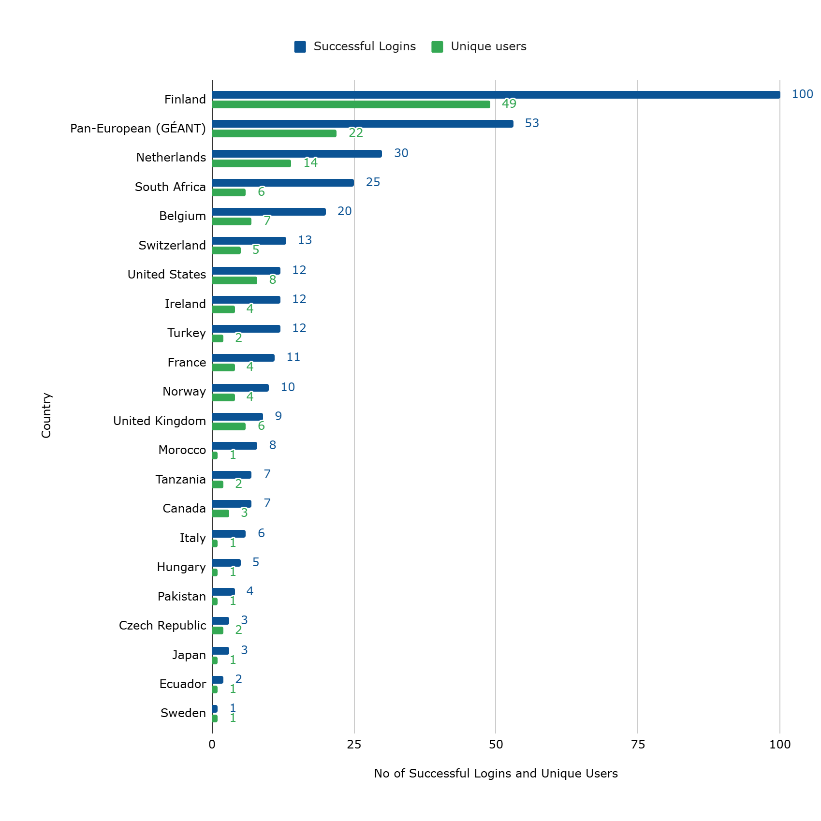
Over the course of the final proof of concept deployment, the three devices taken to Helsinki and Istanbul recorded successful authentications from users representing more than 20 countries and a wide range of institutions across the global research and education community. Finland recorded the highest number of successful logins with 100 authentications from 49 unique users, followed by the pan-European GÉANT community with 53 authentications from 22 unique users. Additional successful connections were recorded from users in the Netherlands, South Africa, Belgium, Switzerland, the United States, Ireland, Türkiye, France, Norway, the United Kingdom, Morocco, Tanzania, Canada, Italy, Hungary, Pakistan, Japan, Sweden, Ecuador, and the Czech Republic.
The diversity of institutions represented was equally significant. Users connected using identities issued by leading universities and National Research and Education Networks from around the world, including GÉANT, SURF in the Netherlands, TENET in South Africa, Internet2 in the United States, Jisc in the United Kingdom, GARR in Italy, SWITCH in Switzerland, RENATER in France, TERNET in Tanzania, APAN in Asia Pacific, CANARIE in Canada, and several Finnish universities, including the University of Helsinki, Aalto University, Tampere University, and the University of Turku.
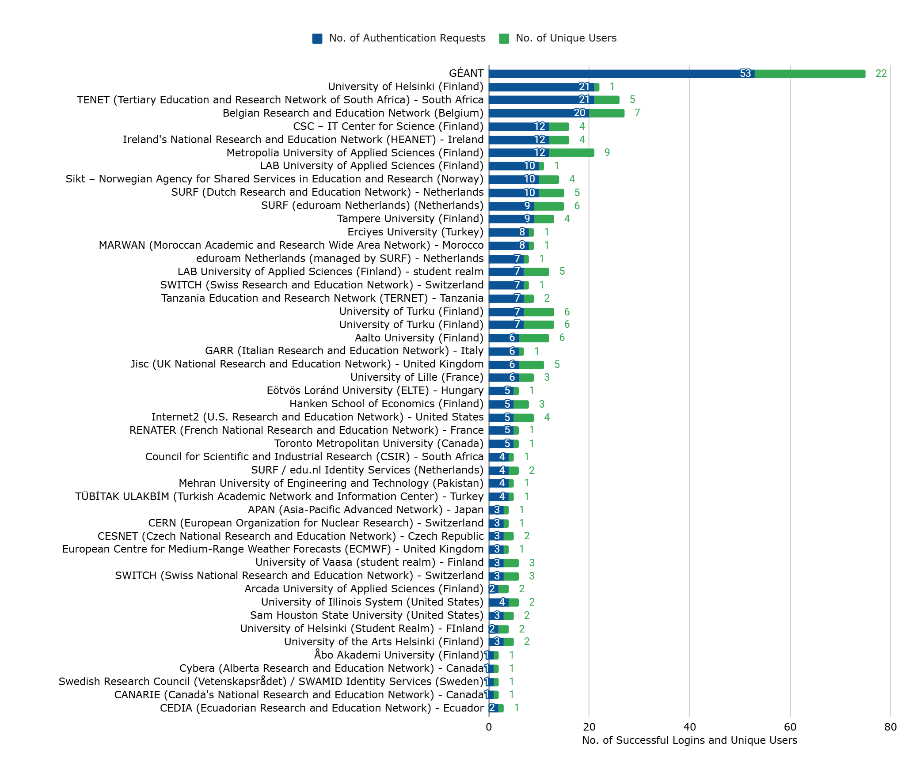
Researchers, students, network engineers, educators, and technology leaders were able to authenticate instantly using credentials from their home institutions, just as they would on their own campuses, despite being thousands of kilometres away.
For RENU, our presence at TNC26 was not the story. It was the proof.
The deployment demonstrated that eduroam on the Go can provide secure, trusted, and portable eduroam services across borders, allowing institutions to extend connectivity to their users wherever they travel. What began as an innovation to support mobility within Uganda has now been validated as a solution capable of supporting the global research and education community.
The implications extend far beyond conferences and international events.
Researchers conducting fieldwork in remote locations can remain connected through trusted institutional identities. Students participating in exchange programmes can access secure connectivity without relying on temporary accounts or purchasing local SIM cards every time they travel. Institutions of higher learning can support learning, teaching, and collaboration beyond campus boundaries.
More broadly, the successful deployment demonstrates how eduroam’s global trust framework can support secure academic connectivity across countries while maintaining the simplicity and security users already experience on campus. It also demonstrates the potential for eduroam on the Go to support secure connectivity across more than 190 countries and territories worldwide.
As research and education become increasingly international, connectivity must evolve to support a community that is constantly on the move. eduroam on the Go shows that trusted access to digital resources no longer needs to be tied to a physical campus, a fixed location, or even a single country.
From a concept developed in Uganda to successful deployments across multiple countries, eduroam on the Go is proving that the future of research and education connectivity is portable, secure, scalable, and global. For researchers, students, educators, and technology professionals, it is becoming a trusted travel companion that keeps them connected wherever learning, research, and collaboration take them.
It is not simply extending eduroam coverage.
It is extending the reach of the global research and education community itself.