
Kampala, Uganda – Tuesday 1st September 2026
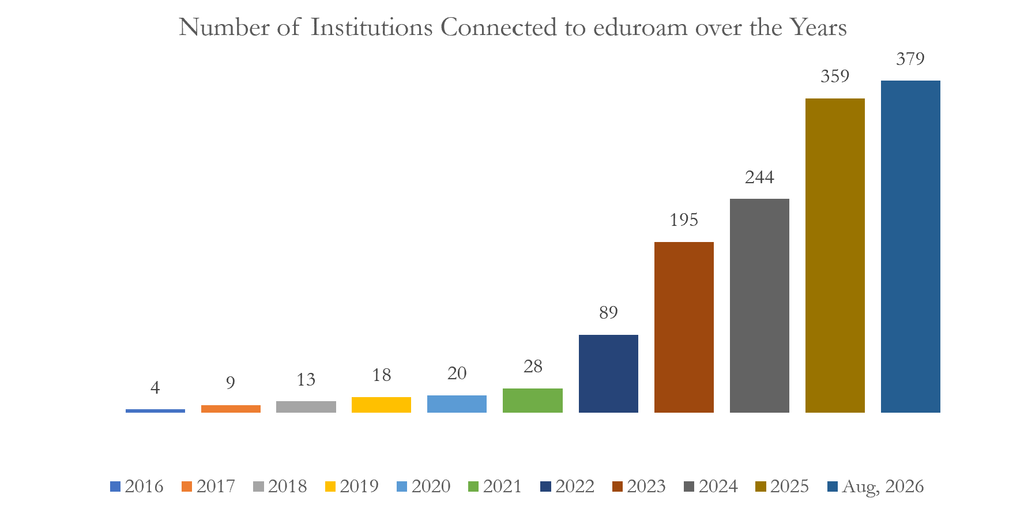
Figure 1: Number of Institutions using eduroam in Uganda
From the shores of Lake Victoria and the source of the River Nile in Jinja, to the snow-capped Rwenzori Mountains and the Equator crossing at Kayabwe, Uganda is a country shaped by striking landscapes, long distances and diverse communities. Across this terrain lies a growing research and education ecosystem, stretching from major universities in Kampala to institutions, students and researchers in towns and communities across the country. In such a setting, reliable connectivity is more than a convenience; it keeps people connected to learning, research and opportunity.
It is within this uniquely Ugandan landscape that the country’s eduroam story has unfolded.
Ten years ago, a student travelling from one university to another in Uganda could not necessarily expect to remain connected. A visiting researcher could arrive at another institution and had to find an ICT administrator, request temporary login credentials and wait before getting online.
Today, that experience is remarkably different.
A student can leave their home university and connect to the Internet at another participating institution using the same login credentials. A researcher can travel abroad and remain connected to eduroam in a university in another country. In Uganda, that connection has moved even further, from university campuses into student hostels, libraries, public spaces, and towns across the country. It can even travel with a researcher in their pocket.
This is the story Uganda celebrates in 2026: ten years of eduroam.
The anniversary comes at a time when connectivity has become inseparable from education and research. Uganda has made significant progress in expanding Internet access, yet meaningful connectivity remains uneven. By December 2025, the Uganda Communications Commission (UCC) reported 18.5 million active Internet subscriptions and broadband infrastructure covering an estimated 85% of the country geographically. However, affordability, digital skills and access to relevant content continue to limit meaningful Internet use.
For a student, those gaps are experienced in everyday moments: whether there is enough data left to finish a virtual lecture, whether an assignment can be uploaded before a deadline, or whether a journal article can be downloaded without exhausting a data bundle. For a researcher, the same connectivity gap can determine whether data reaches collaborators, an international meeting is attended, or an online research resource remains out of reach.
Against this backdrop, Uganda’s eduroam story is about much more than Wi-Fi. It is about making learning more accessible, research more mobile and knowledge less constrained by location.
Uganda Takes its Place on the Global eduroam Map
eduroam (short for education roaming) is a global wireless roaming service developed specifically for the research and education community. It allows students, researchers, lecturers and staff of participating institutions to securely access the Internet at eduroam-enabled locations using credentials (email address and password) issued by their home institution.
The global eduroam journey began in 2003 with initial trials conducted among five institutions in the Netherlands, Finland, Portugal, Croatia, and the United Kingdom. Later, other national research and education networking organisations in Europe embraced the idea and gradually started joining the infrastructure, which was then named eduroam.
Uganda joined the global eduroam community on 7th January 2016, when the Research and Education Network for Uganda (RENU) was officially recognised as the world’s 75th National Roaming Operator (NRO) for eduroam.
For Uganda’s research and education community, that recognition opened a door to a much larger academic world. A Ugandan researcher arriving at a participating university thousands of kilometres from home can open a laptop and connect instantly and securely. In the same way, a researcher arriving in Uganda can step onto a participating campus and find the same trusted network waiting.
What started with a relatively small number of participating Ugandan institutions has since developed into one of Africa’s most extensive eduroam deployments. The global eduroam monitor currently records 727 service locations in Uganda, the highest reported number among the African countries listed on the platform.
RENU’s records also show participating institutions growing from 1 in 2016 to close to 400 by August 2026, and the number of successful and unique logins gradually grew over the years. But Uganda’s most important contribution to the eduroam story may not simply be how much the service grew. It is how the country adapted it when circumstances demanded something different.
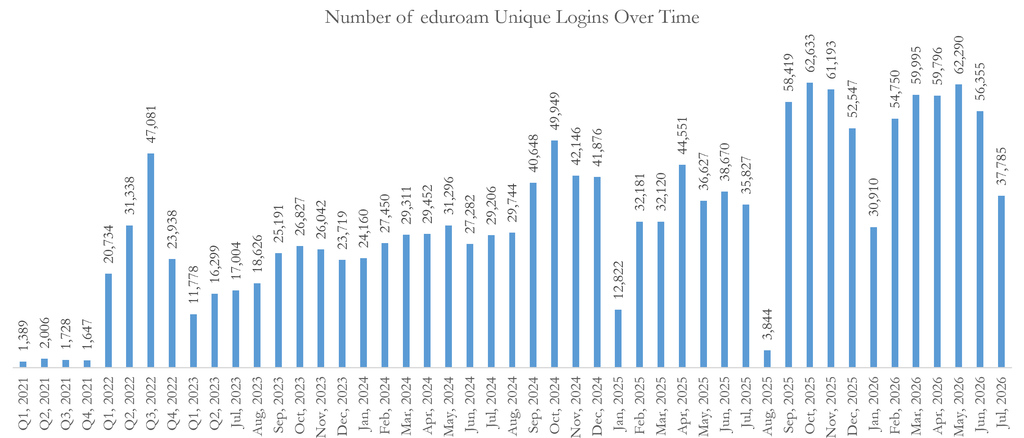
Figure 2: Number of eduroam Unique Logins over the Years
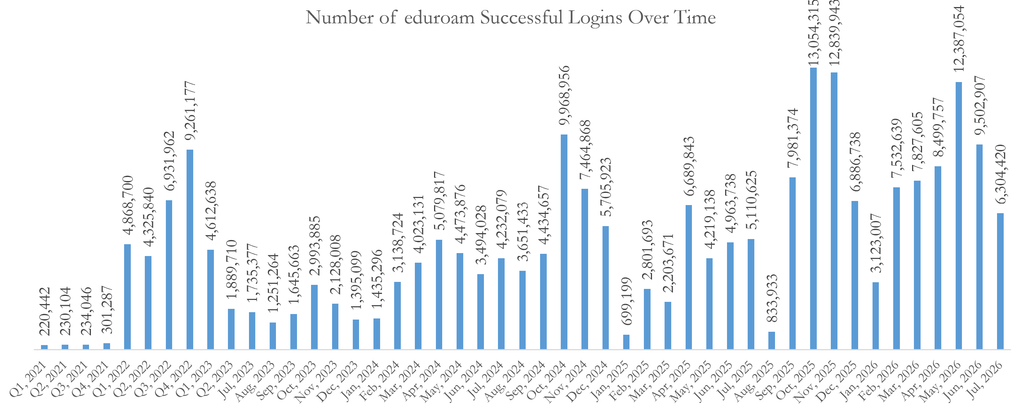
Figure 3: Number of eduroam Successful Logins over the Years
The Network that Followed Learners during the COVID-19 Pandemic
In 2020, the familiar rhythm of university life suddenly stopped. When campuses were closed due to the COVID-19 pandemic, eduroam followed the learners. Lecture rooms emptied. Campus gates closed. Students returned home or remained in hostels as COVID-19 restrictions changed how and where education could take place. Lectures moved onto screens, meetings shifted to videoconferencing platforms, and researchers still needed access to journal databases and collaborators.
The Internet connection that many students had previously accessed as part of campus life was suddenly no longer available to them.
For those relying on mobile Internet, education began to compete for every megabyte of a limited data bundle. A student could sit through a virtual lecture knowing that the longer it lasted, the less data remained for downloading readings or submitting coursework. Others were trying to study from locations with slow or unstable connectivity. The problem was therefore not simply whether Uganda had Internet coverage. It was whether a learner could afford to remain connected long enough to learn.
RENU responded by asking a different question: if learners could not come to the network, could the network go to them? eduroam was the saviour!
On 1st September 2020, Metro eduroam was launched. More than 300 hotspots were commissioned across Kampala, Mukono and Entebbe during the first phase. Instead of ending at the university gate, eduroam began appearing in student hostels, cafes, libraries and other public spaces.
For a student living in a hostel in one of these areas, that changed the geography of learning. The classroom might have been closed, but the connection to it no longer had to be. Eligible students, lecturers and researchers could use the same institutional credentials they had previously used on campus. By Metro eduroam’s first anniversary, the service had recorded 609,916 successful logins from 1,556 unique users.
What had begun as a campus roaming service was becoming something different in Uganda: a wider academic connectivity network woven into the places where students actually lived and studied.
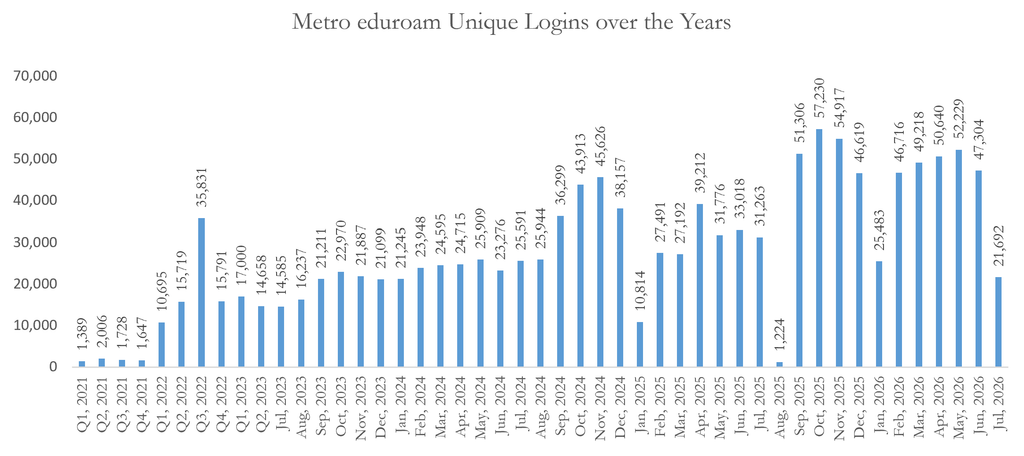
Figure 4: Number of Metro eduroam Unique Logins over the Years
Taking eduroam Across Uganda
The need did not disappear when campuses reopened.
If anything, the pandemic had exposed a permanent change in education and research. A lecture could happen in a classroom or online. A postgraduate student could meet a supervisor without being in the same town. A researcher could be collecting data far from campus while still needing access to journal cloud platforms and colleagues.
In May 2022, with support from the Internet Society Foundation’s Building Opportunities/Leveraging Technologies Project, Metro eduroam expanded to 18 additional towns. The expansion began to change the map of eduroam in Uganda. What had initially concentrated around Kampala, Mukono and Entebbe was moving further into the country’s different regions, bringing the service closer to universities, students and researchers whose academic lives existed far beyond the capital.
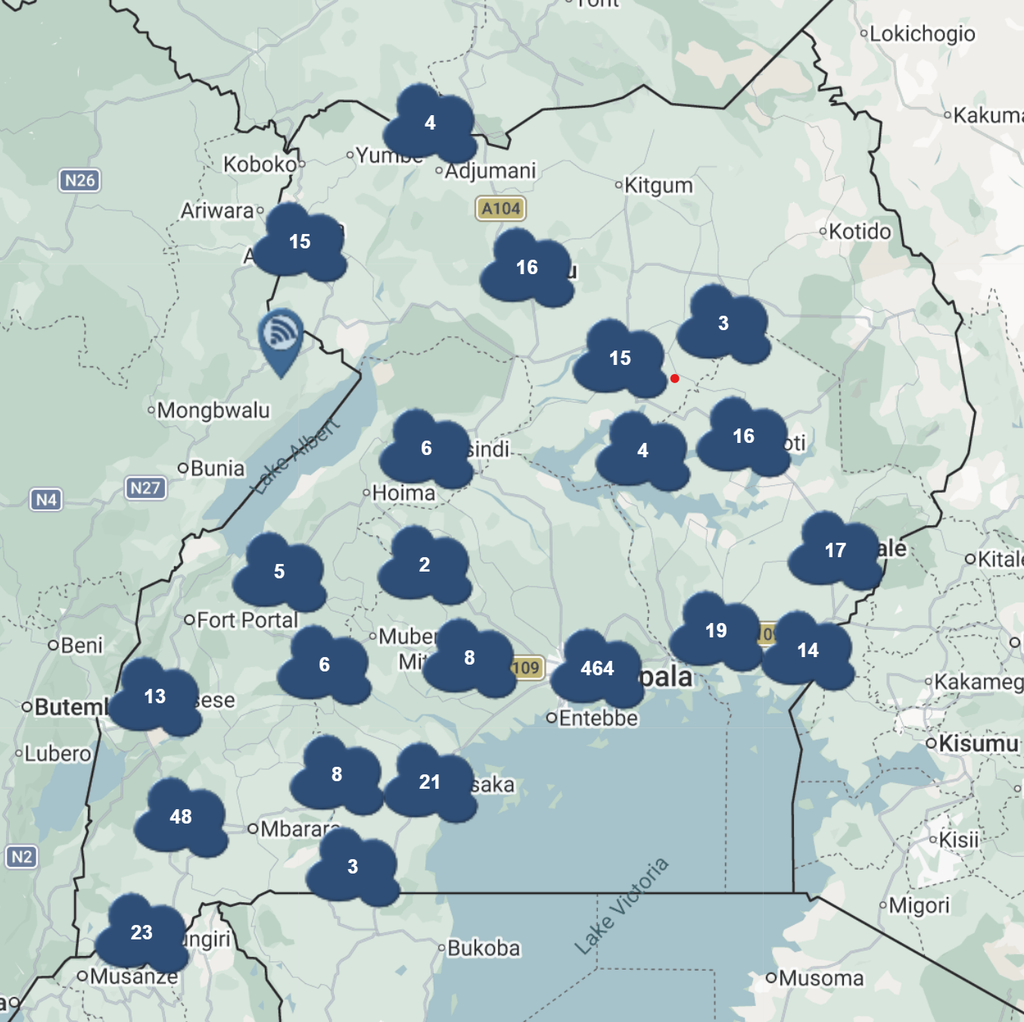
Figure 5: eduroam hotspot locations in Uganda (https://eduroam.renu.ac.ug/)
But distance was only one challenge.
Keeping a hotspot running in a busy urban area with dependable infrastructure is very different from sustaining one in a location where electricity can disappear without warning. Some early hotspots depended on commercial infrastructure that was expensive to maintain. Power interruptions affected availability, while limited monitoring made faults harder to detect and resolve. In some locations, providers eventually shut down hotspots.
Those realities could have limited the expansion of Metro eduroam. Instead, they became a reason to innovate.
Uganda has abundant sunshine. RENU began turning some of it into connectivity. One of the most distinctive developments in the country’s eduroam journey has been the introduction of locally manufactured, solar-powered Internet routers. Developed through RENUMESH Technologies, the routers reduced dependence on conventional electricity supplies. In places where a power interruption could otherwise silence a hotspot, solar energy offered another way to keep the connection alive.
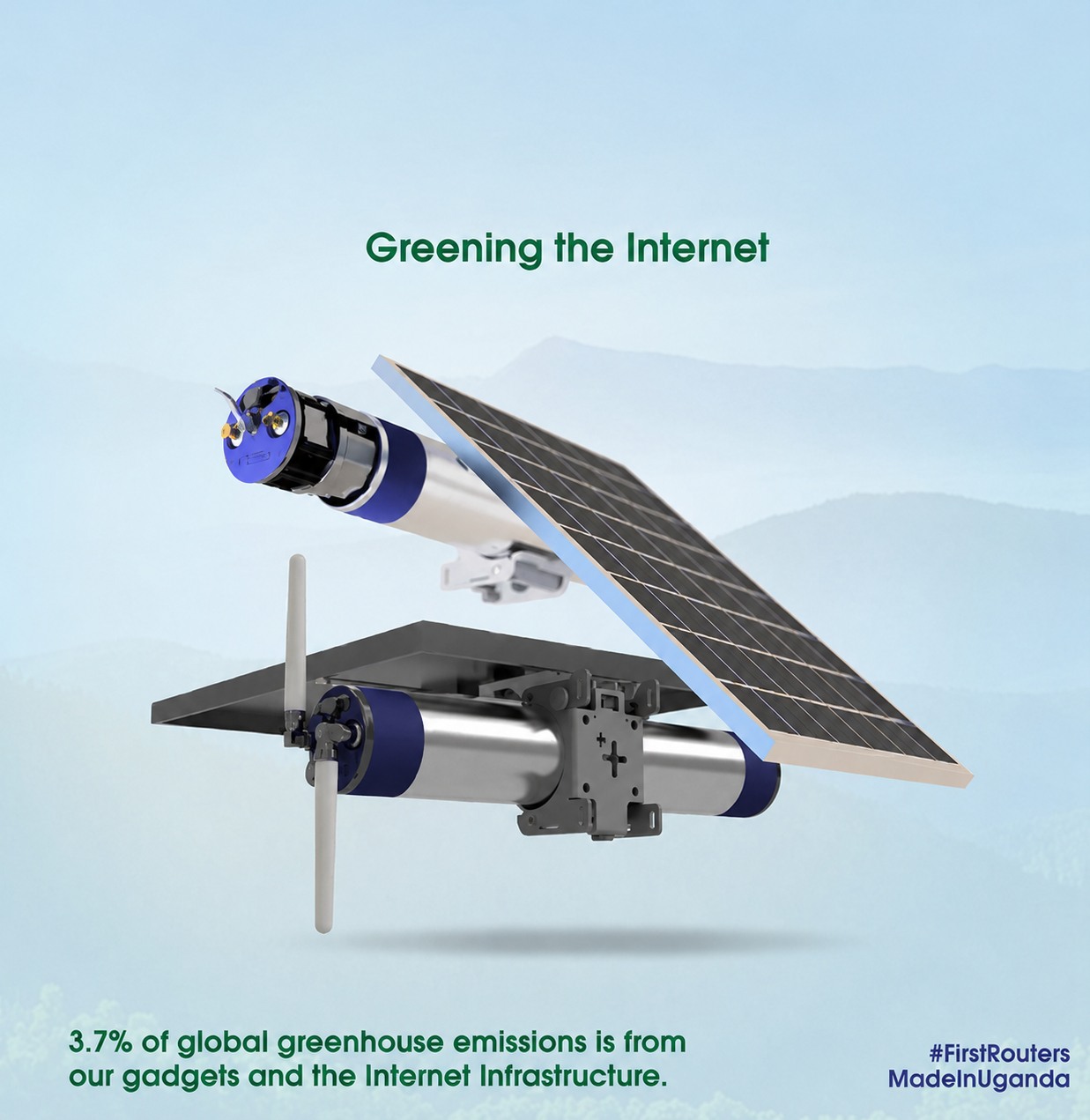
Figure 6: A Solar-powered Router
The approach also reduced the need for expensive electrical installations in some locations and introduced improved remote monitoring, allowing technical teams to see how equipment was performing without necessarily having to travel to the site first – meaning that RENU now had full control of the quality and consistency of the Metro eduroam service By the end of 2024, Uganda had approximately 600 eduroam hotspots, including 150 powered by solar energy.
There is something distinctly Ugandan about that part of the story: a global research and education service being extended through technology manufactured locally and redesigned around the realities of operating infrastructure in Uganda.
Demand was growing too. Capacity used by Metro eduroam increased from approximately 100 Mbps in 2022 to 1 Gbps by April 2025. And in 2024, along the Masaka–Mbarara Highway, eduroam reached one of Uganda’s most recognisable landmarks.
Connecting at the Equator
At Kayabwe, the highway to the West crosses the Equator. It is a place where travellers stop to stand with one foot in the northern hemisphere and another in the southern hemisphere, take photographs and continue their journeys through Uganda.
Today, members of the global research and education community can also find eduroam there.
For a service built around academic mobility, the location is particularly fitting. A network that began within university campuses can now meet a researcher or student while travelling through one of Uganda’s best-known geographical landmarks.
The hotspot at Kayabwe may be only one point on Uganda’s growing eduroam map, but it captures something much larger about the country’s ten-year journey: the connection has steadily followed its users beyond the traditional boundaries of the campus.
RENU Puts eduroam in a Pocket
There was still another problem to solve. A researcher conducting fieldwork or an academician cannot always choose where the work takes them. It may mean leaving an office early in the morning, travelling for hours and spending the day collecting information or teaching somewhere far from the nearest campus or fixed eduroam hotspot. Yet the researcher or educator may still need to communicate with colleagues, access an online system, upload information or join a meeting.
Fixed infrastructure alone cannot follow every researcher to every field site.
In 2022, RENU introduced eduroam on the Go, a pocket-sized router that allows authorised university staff and researchers to carry eduroam connectivity with them. The concept changed the relationship between the user and the network. Instead of always travelling to an eduroam location, eduroam could now travel with the user.
For researchers moving between field sites, academics attending workshops and university staff working temporarily away from campus, eduroam became more portable. Together, the three approaches created an increasingly flexible ecosystem: eduroam on campus, Metro eduroam within communities and eduroam on the Go for users in motion.
The future of research and education connectivity is mobile.
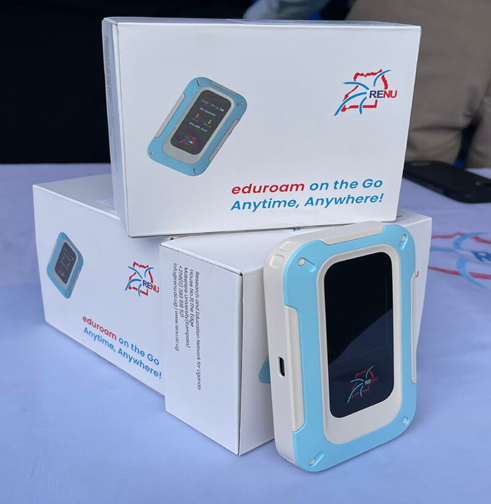
Figure 7: eduroam on the Go MiFi
When Connectivity Changes Everyday Student Life
The significance of that infrastructure becomes clearest in the people who use it.
Travel Southwest from Kampala towards Kabale, or North towards Gulu, West Nile and Lira, and the statistics begin to acquire human meaning. At Kabale University, one student shared that his daily expenditure on mobile data fell from approximately UGX 2,000 to UGX 500 after gaining access to Metro eduroam.
At Lira University, another student reported that monthly expenditure dropped from nearly UGX 16,000 to around UGX 5,000 and sometimes nothing because he has access to eduroam.
These individual experiences are not a national assessment of student Internet expenditure. But for a student managing transport, meals, accommodation, books and other daily expenses, the difference between buying data every day and accessing academic connectivity through eduroam can matter.
The impact is also about where and when students can learn.
At Nkumba University in Entebbe, Bwire Derrick Emmanuel, a Bachelor of Information Systems and Technology student, describes a routine that will be familiar to many university students.
“I used to stay in the library until late at night just to upload assignments. Now, I do everything from my hostel room. It feels safer and more convenient.”
His experience captures a dimension of connectivity that is easy to overlook. When the reliable Internet connection is on campus, a student may have to organise their evening around that location. An assignment due at night can mean remaining at the library longer than intended simply because that is where the connection is.
Metro eduroam moved that connection closer to where students live.
For fellow Nkumba University student Kibirige Henry, it has created another kind of freedom.
“eduroam has made it possible for me to study late at night after leaving campus to improve my coding skills when it is calm. As a student, this flexibility is invaluable.”
In some university towns, connectivity has become important enough to influence where students choose to live. Students ask whether a hostel has an eduroam hotspot before moving in, while some hostel operators increasingly recognise academic connectivity as part of what makes their accommodation attractive.
eduroam is a network service that has quietly become part of student life.
Keeping Uganda’s Researchers Connected to the World
The same network that brings connectivity closer to a student in a Ugandan hostel also connects Uganda to a much larger academic community. Modern research rarely happens within the walls of one institution. Researchers consult journals hosted overseas, share datasets with collaborators in other countries, meet virtually, access cloud-computing environments and move between universities, conferences and field sites.
eduroam removes one small but persistent obstacle from that movement: repeatedly arranging Internet access.
Between 2025 and August 2026 alone, RENU recorded 9,600 unique users from institutions across 70 countries connecting to eduroam hotspots in Uganda, including visitors from South Africa, Belgium, Norway, and the United States.
Imagine a researcher, student or staff from an eduroam subscribing institution arriving in Uganda for various reasons. There is no need to search for a handwritten Wi-Fi password at every participating institution or create a temporary account. The credentials from their home institution can travel with them.
In a network log, that moment appears simply as an authentication. Behind it could be a journal article downloaded in Kampala, a dataset accessed in Entebbe, an email sent to collaborators from another university, or a research conversation continued thousands of kilometres from where it began.
That is what global academic roaming looks like in practice.
When eduroam Becomes the Campus Network
Perhaps one of the strongest signs of confidence in eduroam is when an institution stops treating it as an additional wireless network altogether. Several Ugandan institutions have taken that step.
Lira University adopted eduroam as its exclusive campus Wi-Fi network name following technical assistance from RENU in 2019. The transition involved infrastructure upgrades, training for the ICT team and sensitisation of users.
Uganda Christian University, one of RENU’s founding members and an early eduroam adopter, uses eduroam as the sole SSID across all five of its campuses and complements it with Metro eduroam hotspots and eduroam on the Go devices.
Uganda Martyrs University (UMU), Soroti University, Islamic University in Uganda (IUIU) and Muteesa Royal University (Masaka Campus) have also adopted eduroam as their only campus wireless network, embedding the service into the everyday digital experience of their students, staff and researchers.
Heritage International School and Maryhill High School similarly adopted eduroam to provide a secure single-sign-on network while maintaining institutional control.
Walk onto these campuses, and eduroam is therefore not simply a special network reserved for visitors or occasional roaming. It is the wireless network through which everyday academic life happens: students access learning platforms, staff communicate, researchers work, and visitors from participating institutions connect.
The evolution from an additional Wi-Fi option to the campus network itself represents something important. It demonstrates that eduroam has become a trusted infrastructure, trusted, secure and scalable enough for institutions to build their daily digital experience around it.
Ten Years Built Together
Uganda’s eduroam journey has never been the work of one organisation.
Behind every successful connection is a chain of cooperation extending from an institution in Uganda to regional and global research and education networks.
GÉANT provides the global framework through which national research and education networks participate in eduroam. The UbuntuNet Alliance strengthens the regional research and education networking environment in which RENU operates. Early support from the Kenya Education Network (KENET) and the Tertiary Education and Research Network (TENET) of South Africa helped RENU deepen its understanding of eduroam, while the Network Startup Resource Center (NSRC) provided technical mentorship.
The Internet Society Foundation supported the expansion of Metro eduroam and the piloting of solar-powered connectivity. The Uganda Communications Commission (UCC), through the Uganda Communications Universal Service and Access Fund (UCUSAF), has supported initiatives aimed at expanding connectivity within Uganda’s education community, particularly in extending eduroam to 400+ schools.
But the network ultimately reaches people because institutions make it work locally.
Universities, Other Tertiary Institutions, research organisations, health centres and schools have invested in infrastructure, strengthened identity management systems, trained ICT teams, and helped students and staff understand how to connect. Hostel owners and other partners have provided locations from which Metro eduroam can reach users beyond campus.
Students, lecturers and researchers then transform all of that infrastructure into impact simply by using it to learn, teach, discover and collaborate.
The Next Decade: Making Every Connection Count
Ten years after Uganda joined the global eduroam community, the country’s progress can be measured in hotspots, institutions, authentications and network capacity.
Those numbers matter. But they are not the whole story. The next decade presents a bigger challenge: ensuring that every connection creates greater opportunity.
That means extending coverage further into rural institutions, schools, research sites, libraries, student accommodation and underserved communities. It means strengthening identity management, cybersecurity awareness and institutional technical capacity. And it means ensuring that connectivity becomes a gateway to digital libraries, open science, virtual laboratories, cloud computing, Artificial Intelligence and the next generation of research and learning tools.
Uganda entered the global eduroam community in 2016 as the 75th National Roaming Operator. Ten years later, the global eduroam monitor records 727 service locations in the country, the largest reported footprint among the African countries currently listed. That is what ten years of eduroam in Uganda looks like.
In ten years, Uganda has taken a global idea and extended, adapted and innovated around the realities of its research and education community.
In the next 10 years, every research and education institution in Uganda must be connected to eduroam.