Kampala, Uganda – Monday, 2nd November 2026
Imagine a Ugandan researcher who has spent months studying how changing rainfall patterns are affecting agricultural productivity. After collecting data, analysing findings and preparing a research paper, the results are finally published. The study could inform agricultural policies, improve farming practices or inspire further discoveries. But what happens after publication? Will another researcher investigating a similar problem elsewhere discover the findings? Can policymakers easily locate and reference the study? And will the researcher receive proper recognition when others build upon the work? These questions highlight an important challenge: producing valuable research is one achievement, but ensuring others can find, recognise, and use it is equally important.
Across Uganda, universities and research institutions generate journal articles, datasets, dissertations, conference papers and other scholarly outputs that contribute to scientific discovery and national development. However, some of this work remains difficult to discover, accurately reference or connect to related research, limiting its impact in global research. To help address this challenge, the Research and Education Network for Uganda (RENU) has become a Crossref Sponsor Organisation and a DataCite Consortium Lead in Uganda, enabling institutions to access DOI registration services that strengthen the visibility, discoverability, and recognition of their research outputs. The services from Crossref and DataCite complement RENU’s existing ORCID initiative, creating more opportunities for Ugandan researchers, publications and research data to become more visible and better connected to the global research community.
DataCite: Giving Research Data the Recognition it Deserves
Not every valuable research contribution takes the form of a journal article. A scientist studying Lake Victoria may collect years of data on water quality, while an agricultural researcher may generate datasets on crop yields, or a public health team may develop software that other scientists can use. These outputs can be just as valuable as the publications they supported, yet many of these outputs remain unutilised because they are difficult to find or reference since they lack clear information about their creators, content or location. DataCite helps address this challenge by enabling institutions to assign DOIs to research datasets, software, theses and other scholarly materials. For example, a Ugandan research team that has spent several years collecting data on soil conditions can register its dataset with a DataCite DOI, making it easier for other researchers to identify, reference and potentially reuse the information, subject to the appropriate access conditions.
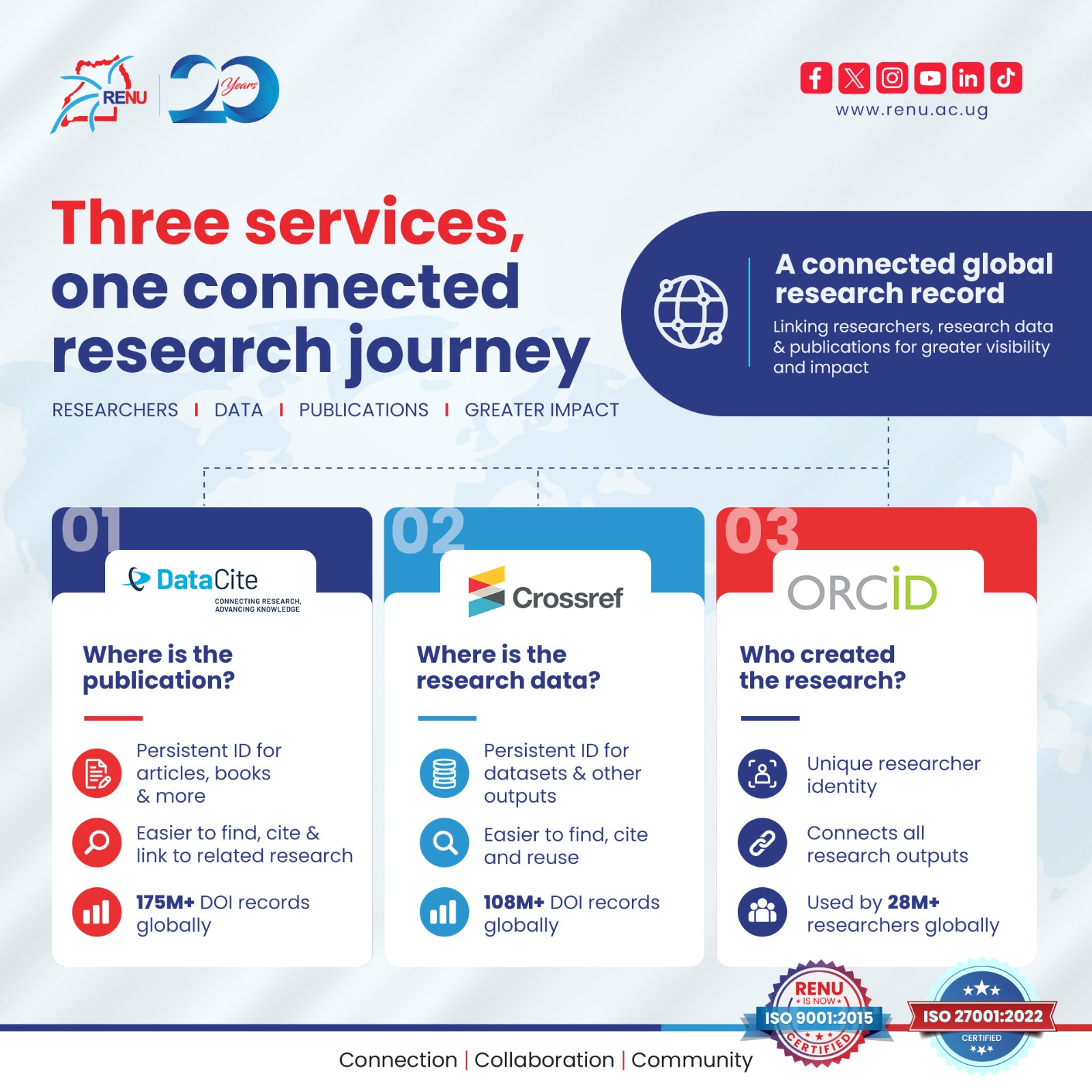
The scale of DataCite’s global adoption demonstrates the growing importance of recognising research data as a valuable scholarly output. According to DataCite’s 2025 public data release, its community registered more than 140 million DOIs during 2025, bringing the number of findable DOI records to approximately 108 million by the end of the year.
As a DataCite Consortium Lead in Uganda, RENU is helping Ugandan institutions strengthen the way they identify, manage, and share information about their research outputs. This is particularly important for research that depends on the ability to verify findings, reuse existing data and build upon earlier discoveries. By making research data easier to identify and cite, institutions can help ensure that valuable knowledge generated in Uganda continues contributing to scientific advancement long after the original project has ended.
“We are delighted to welcome the Research and Education Network for Uganda (RENU) to the DataCite community and mark the establishment of the first DataCite Consortium in Uganda, led by RENU. This consortium provides a sustainable, collaborative, and cost-effective pathway for research organizations across Uganda to adopt DataCite DOIs and connect their outputs to the global scholarly ecosystem.
Aligned with DataCite’s mission to empower a global community of research organizations, this partnership will strengthen Uganda’s research infrastructure through DataCite services that support persistent identifier creation, open metadata, and FAIR practices.”Maria Gould, DataCite Director of Strategic Programs and Partnerships
Crossref: Making Ugandan Publications Easier to Find and Cite
Every year, researchers at Ugandan universities publish findings that address some of the country’s most pressing challenges in areas such as public health, food security, education, climate change and technological innovation. Yet an important research paper can have limited reach if other researchers cannot easily locate or reference it. Crossref addresses this challenge. Crossref, as an official DOI registration agency, enables scholarly publishers to mint, assign and register permanent Digital Object Identifiers (DOIs) to publications such as journal articles, conference papers, books and research reports. In simple terms, a DOI is a unique, lasting identifier for a publication. Think of it as a publication’s digital identity, which helps people find and cite the correct work even when it or the publication changes digital location.
Consider a Ugandan university journal publishing a study on malaria prevention. With Crossref, the publisher assigns the article an identifier (DOI) and records the publication’s important information (metadata), such as the title, authors, journal, and publication date. This makes it easier for other researchers, libraries and scholarly platforms to identify and connect the publication to related work. The scale of this global system is remarkable. By November 2025, Crossref had registered approximately 175 million DOI records through 23,622-member organisations across 164 countries.
As a Crossref sponsor organisation, RENU helps eligible Ugandan institutions join and use Crossref by supporting onboarding, DOI registration, publication information management and the integration of publishing platforms at a lower cost. For universities and institutional journals, this makes it easier for locally published scholarship to be discovered, referenced, and connected to the wider scholarly record.
Building on ORCID: Giving Researchers a Lasting Identity
While Crossref and DataCite help identify publications and research data respectively, another important question remains: who created the work? Consider two researchers who share the same name, or a researcher whose name appears differently across several publications. Without a unique, consistent identifier, their scholarly contributions may be difficult to distinguish. ORCID helps solve this problem by providing researchers with a unique and lasting digital identifier, known as an ORCID iD, which connects them to their scholarly contributions throughout their careers. The global ORCID registry has grown to more than 28 million identifiers, illustrating the increasing importance of reliable researcher identification.
RENU established the ORCID Consortium of Uganda on 13th October 2025 to help institutions access organisational membership, technical integration and training through a shared arrangement. Currently, the consortium has 14 members and continues to grow. Through the Uganda ORCID Hub, participating institutions can connect researchers and students to their ORCID records and, with their permission, add verified information such as institutional affiliations. In May 2026, the Uganda ORCID Hub was recognised as an ORCID Certified Service Provider, marking an important milestone for the initiative.
With Crossref and DataCite services now part of RENU’s scholarly services portfolio, institutions have additional opportunities to connect researchers’ identities to their publications and research data.
One Research Journey, Three Complementary Services
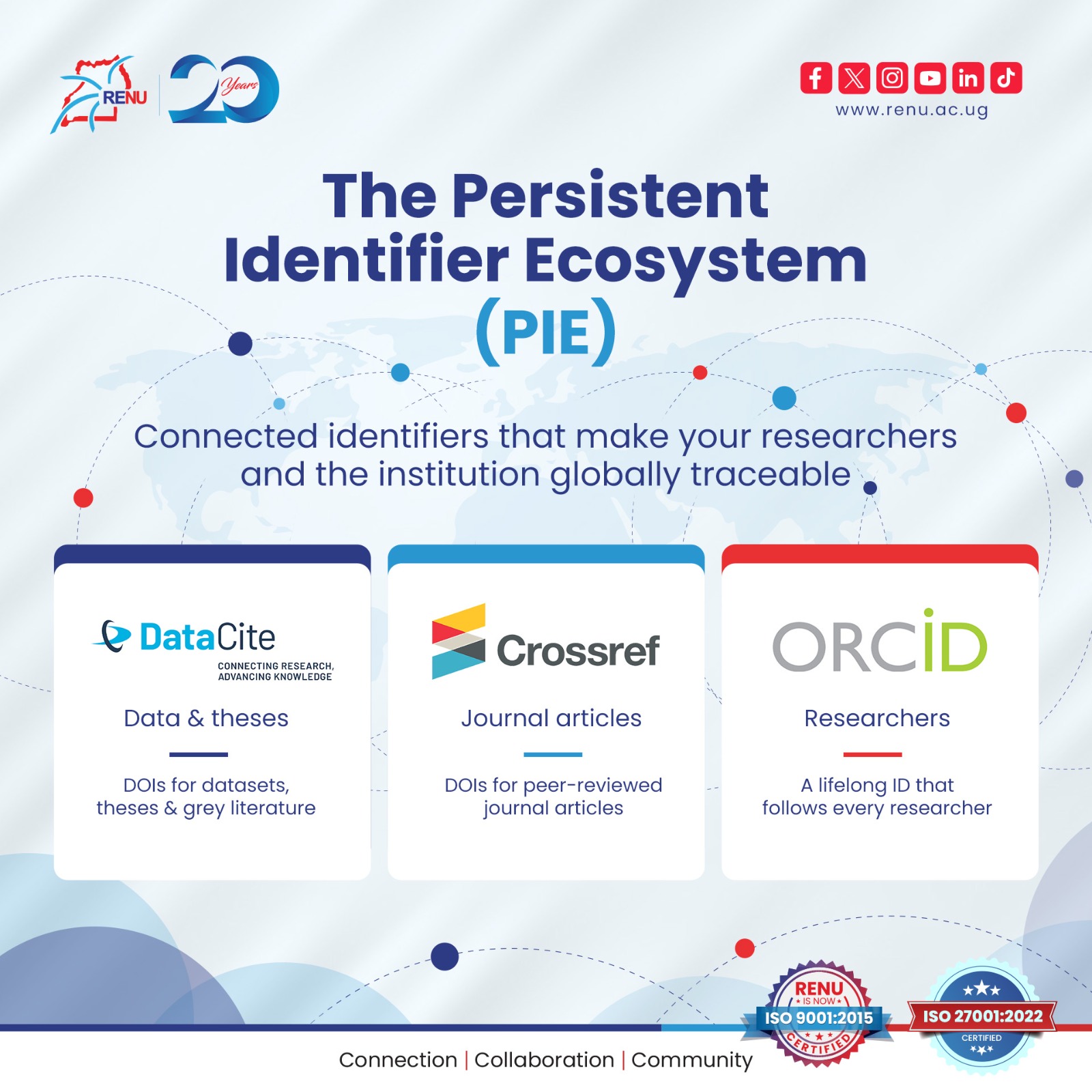
The significance of these services becomes clearer when we consider how they work together. Imagine a research team at a Ugandan university investigating changes in Lake Victoria’s ecosystem. The team collects information about water quality, fish populations and environmental conditions before publishing its findings in a journal and depositing the supporting dataset in a research repository. ORCID helps identify the researchers responsible for the study, DataCite provides a lasting identifier for the dataset, and Crossref provides a lasting identifier for the published article. When the records contain accurate information and links to one another, someone discovering the publication can trace its supporting data, while another researcher finding the dataset can locate the article explaining the findings.
Together, these services help create a connected scholarly record in which researchers, publications and research data can be accurately identified and linked. For Ugandan universities and research institutions, this can strengthen institutional repositories, improve scholarly publishing, support research reporting and increase opportunities for collaboration. University libraries can make their collections easier to discover, journal publishers can improve the identification and citation of their publications, and research administrators can maintain more consistent records of institutional research contributions. Importantly, a DOI does not automatically make research publicly accessible or guarantee citations. Its value depends on accurate information, maintained records and appropriate access to the underlying work.
Making Ugandan Research Count Beyond Publication
Uganda’s research and education institutions play an important role in generating knowledge that addresses local challenges and contributes to global scientific understanding. From agricultural studies supporting food security to public health research informing disease prevention, the value of this work should not end when a report is submitted or an article is published. It should remain discoverable, identifiable and available for others to reference and build upon, all of which increase Uganda’s research impact globally, which can translate into improved rankings of our individual universities.
RENU invites universities, research institutions, libraries, journal publishers and graduate schools to explore how Crossref and DataCite services can support their scholarly activities and complement existing ORCID services.
Producing research is only the beginning. Ensuring that it can be found, recognised and built upon is what allows its impact to travel further.