
Kampala, Uganda — 16th March 2026
Makerere University and the Research and Education Network for Uganda (RENU) have commissioned the National AI Research Cloud, a major national digital infrastructure milestone designed to accelerate Artificial Intelligence (AI) research, development, and innovation in Uganda by providing high-performance computing capacity and secure storage for research datasets. The Cloud was commissioned on Friday, 13th March 2026, by Hon. Dr. Musenero Monica, the Guest of Honour at the AI Innovation Academy Demo Day, held at the School of Public Health Auditorium, Makerere University Main Campus.
The National AI Research Cloud is part of the AI Innovation Academy being implemented by Pathogen Economy Labs (PEL) in partnership with Marconi Lab and the Mak AI Centre, with financial support from the Science, Technology and Innovation (STI) Secretariat, under the Office of the President of Uganda.
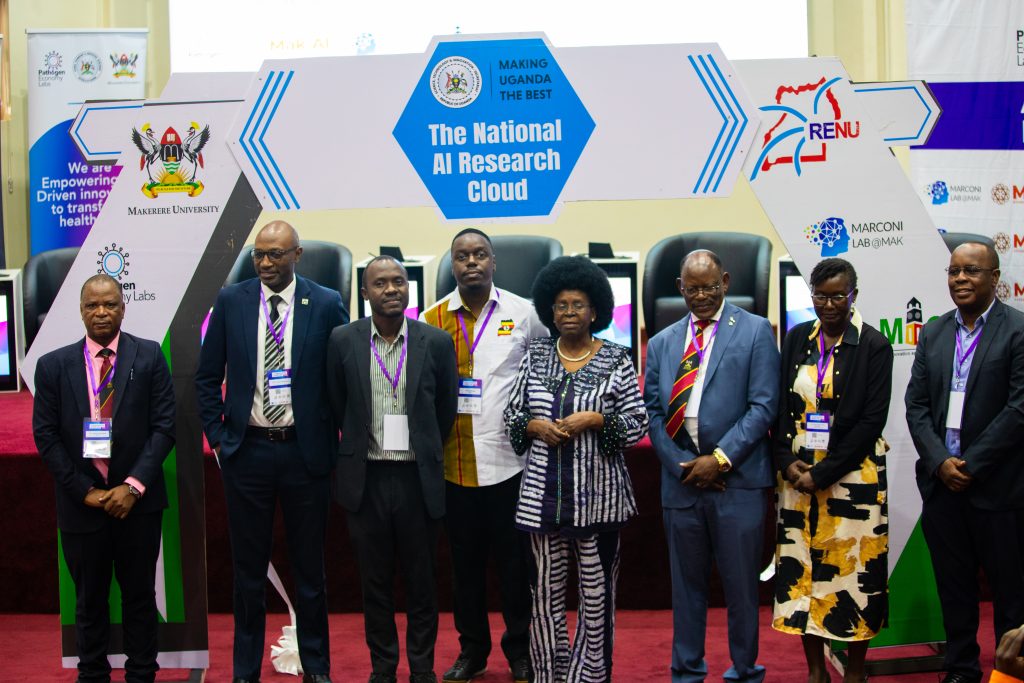
Speaking at the commissioning, Prof. Nawangwe Barnabas, Vice Chancellor of Makerere University, emphasised the role of universities in driving national transformation.
“Today, I feel proud as a Vice Chancellor of an African university because our professors, lecturers, and students are doing what we must do to transform our country, and we can see progress,” he said.
The commissioning took place alongside Demo Day activities, which showcased emerging innovators and prototypes that are being developed under the AI Innovation Academy at Makerere University. While the Demo Day highlights Uganda’s growing talent, the National AI Research Cloud provides the infrastructure required for that talent to scale, from experimentation and academic projects to real-world applications.
Dr. Joyce Nakatumba Nabende, a lecturer in the Department of Computer Science and Head of the Artificial Intelligence Lab at Makerere University, highlighted the critical building blocks required for AI innovation and the importance of this new infrastructure, saying,
“When we are doing AI innovations, there are three important pillars: the data needed to build the models, the compute and cloud or storage to run them, and the skilling. With the cloud launched in partnership with RENU, we are focusing on the key aspect of cloud and compute that is necessary for training models.”
The National AI Research Cloud is a physical computing infrastructure provided by RENU and is designed to support AI model development and data-driven research. The initial deployment comprises servers configured with GPUs and dedicated storage capacity, providing the compute power required for training and testing AI models.
As part of the initiative, RENU will also provide storage for research datasets, supporting responsible research workflows by enabling teams to securely retain, manage, and reuse datasets that underpin AI training and validation.
Brian Masiga, representing the Chief Executive Officer of RENU, underscored the role of enabling infrastructure in research and innovation.
“Our goal is to provide the research and education community, especially researchers and students, with a platform to use Artificial Intelligence to solve societal problems, and RENU is here to provide that infrastructure,” he stated.
Dr. Nabende also emphasized the strategic value of RENU’s role in enabling wider access and collaboration.
“I see this as valuable for us to partner with RENU and for RENU to leverage its connectivity across research institutions to help drive innovation and research in Artificial Intelligence in Uganda.”
Mark Rujumba of Pathogen Economy Labs added that AI research and innovation has often been difficult to pursue at scale due to the cost of training and building AI models. He thus described the commissioning as a pivotal national step.
“The National AI Research Cloud is a major milestone because it gives researchers, students, and developers access to the compute they need to train models and access to datasets.”
The first beneficiaries of the National AI Research Cloud will be participants of the Innovation Academy, which combines Artificial Intelligence and Machine Learning technical training with structured business incubation and investor readiness support for university students, early-career professionals, and startup founders selected through a rigorous screening and interview process.
With national leadership and coordination, the Cloud is intended to evolve beyond the initial cohort into a national platform serving the Government of Uganda, universities, research institutions, startups, and the wider innovation ecosystem, supporting Uganda’s ambition to build local AI capability anchored in national priorities.
Hon. Dr. Musenero also hinted at the national resolve for Uganda to be an active player by saying,
“We should not position ourselves as consumers of Artificial Intelligence; Uganda will not be disadvantaged by this industrial revolution, we will be the creators of advantage.”
As Dr. Nabende enlightened, AI development depends on two foundational resources: compute (the processing power required to train and run models) and datasets (the structured research data used to train and validate them). The National AI Research Cloud addresses both needs by providing a shared environment where researchers and innovators can access compute resources while also benefiting from dedicated dataset storage, supporting replication, continued learning, and improvement of AI solutions over time.
The commissioning of the National AI Research Cloud is a major step toward strengthening Uganda’s innovation pipeline by giving creators the compute and dataset capacity needed to build, test, and improve real-world AI solutions. By lowering the infrastructure barrier, this initiative is expected to help innovators move faster from prototypes to scalable products, catalyse stronger collaboration across the ecosystem, and accelerate AI-driven solutions that address national priorities.